
In today’s world, students need more than an understanding of cultural differences. They also need practical tools to recognize assumptions, communicate across differences, consider other perspectives, and respond to situations where cultural misunderstandings or discrimination can arise. AFS Global Up Teen addresses these needs by combining intercultural knowledge, practical skills, and guided reflection.
AFS Intercultural Programs Switzerland recently brought Global Up Teen to two high school classes at Gymnasium Interlaken and Gymnasium Bern-Kirchenfeld.
The Global Up Teen program combines self-paced digital learning with facilitated dialogue to support students in developing intercultural competence. The online modules introduce concepts such as culture and identity, communication styles, stereotypes and generalizations, cultural adaptation, equity, and equality. Facilitated sessions then give students opportunities to explore and apply these concepts through discussion, simulations, and experiential activities, connecting theory and tools to real-world experiences. Depending on the context, these sessions can take place online or in person.
For the two groups in Switzerland, AFS chose to bring the facilitated sessions into the classroom. The sessions were led by Jennifer Petree, an AFS alumna and trained intercultural facilitator, who worked closely with Gaby Muntwyler, responsible for Intercultural Learning and School Relations at AFS Switzerland, to adapt the activities to the school setting. Thanks to its inherent adaptability, the Global Up program integrates effortlessly into varied educational settings—from entirely online distance learning to in-person instruction, as demonstrated here.
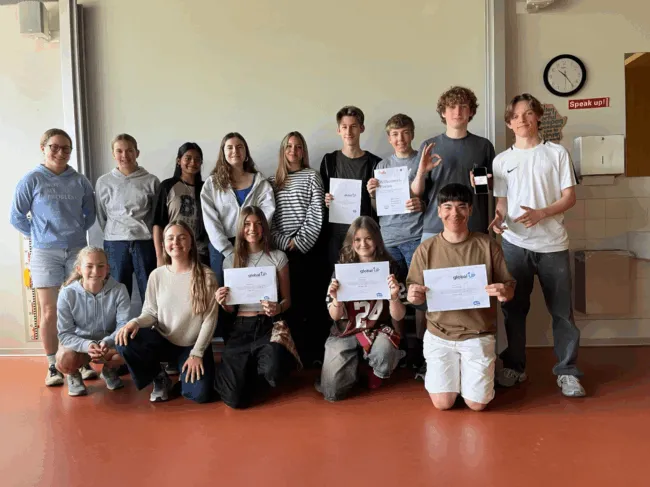
Students at Gymnasium Interlaken with their Global Up Teen certificates, following their classroom learning experience
Students were encouraged to put intercultural concepts into practice rather than simply discuss them. They explored unfamiliar situations from different perspectives and used the D.I.V.E method—Describe, Interpret, Verify, Evaluate—to examine how assumptions can shape the way we interpret other people’s words and actions.
Communication and conflict were another important part of the experience. Students worked through situations involving discriminatory or microaggressive comments and considered how they could respond and support peers experiencing racism. Through simulations and group activities, they had opportunities to practice communication, perspective-taking, conflict resolution, and active allyship in situations connected to everyday interactions.
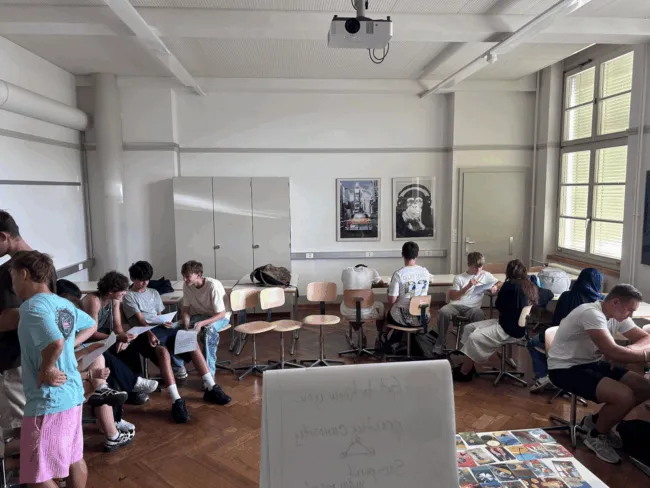
Students at Gymnasium Bern-Kirchenfeld work together during an interactive Global Up Teen classroom activity.
For one student, the value of the experiential activities became clear: “Participating in the simulations helped me realize how easily miscommunication happens when we assume everyone sees the world the way we do.”
The classroom setting also created opportunities for the facilitator to observe group dynamics and guide conversations as they developed. One student highlighted the difference this made to the experience: “Having the facilitator right here in our classroom made a huge difference. It didn’t feel like just another lecture, we were constantly moving, discussing, and testing out ideas together.”
At the same time, the digital modules gave students a shared foundation before they came together for facilitated learning. Operating in synergy, the two components of the experience proved the unique value of a “flipped approach”: students first built knowledge independently and then had space to discuss, question, and apply what they had learned.
Teachers also valued this combination. One teacher described the experience as “the ideal setup,” highlighting the opportunity to see students actively engage in intercultural discussions while practicing English in the classroom.
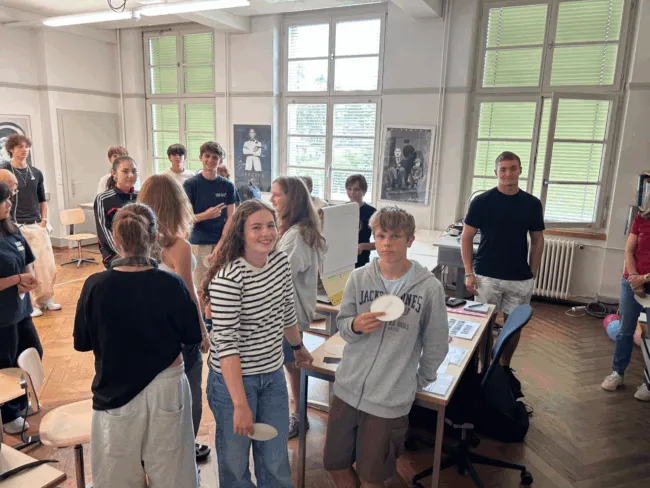
At Gymnasium Bern-Kirchenfeld, students take part in a hands-on activity designed to encourage communication and perspective-taking.
Across the program, students developed a broader understanding of intercultural competence, including analytical observation, adaptive communication, perspective-taking, conflict resolution, and active allyship. They also explored concepts such as stereotypes and generalizations, equity and equality, and the visible and less visible dimensions of culture. Through reflection, they considered how identity, privilege, and context can influence the way people experience the same situation differently.
The experience at Gymnasium Interlaken and Gymnasium Bern-Kirchenfeld illustrates how Global Up Teen can adapt to different learning environments while offering a core learning journey. Whether facilitated sessions take place online or in person, the program connects digital learning with guided practice and reflection.
These experiences bring AFS’s commitment to developing Active Global Citizens directly into the classroom. Through guided experiences that connect knowledge, reflection, dialogue, and practice, students begin to develop key capacities across the four dimensions of AFS’s educational framework: Value & Belong, Inquire Critically, Understand & Relate, and Take Action.
For schools looking to strengthen intercultural learning, Global Up Teen offers a structured yet flexible approach to developing the knowledge, skills, and attitudes students need to navigate an increasingly diverse and interconnected world.
If you would like to bring these transformative experiences to your high school or learn more about our transformative work in Switzerland, please reach out to us at [email protected].